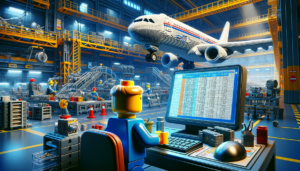

Go Paperless – Create the Digital Factory

About Plataine

Brought by Plataine, a leading provider of AI agents for advanced manufacturing. Plataine’s AI agents optimize planning and scheduling, material management, and supply chain collaboration.
Learn more or check your fit for AI based planning and scheduling.

Is paper work an inseparable part of manufacturing?

Advanced manufacturing processes have always involved paper work traveling with the work order. However, manually logging production information and tracking route cards or printed reports is time consuming, prone to errors and is costly when dealing with vast amounts of data.

Question is: in the era of cloud computing and mobile aps, is it possible to digitize the factory allowing you to become much more efficient, centralize your data and run data queries and analytics?

It’s time to ditch the paper!

The digital revolution (aka Industry 4.0) is already here as more and more manufacturers use industrial IoT sensors to continuously gather and feed manufacturing information replacing much of the manual reporting. Additionally, when operators do require to log information, they use computers and mobile devices instead of papers to keep the information accurate and centralized.

So how do I do I(o)T?

New software solutions that involve both sophisticated software and IIoT-based sensors to store, track, and manage production progress and vital quality data will make tedious manual handling a thing of the past. Use technology that incorporates all relevant information, creating real time visibility as well as allowing to run analytics and reporting.

You can use this technology to create a ‘Digital Thread’, an integrated stream of digital data from the raw material to the finished part that makes information from the entire life cycle of the part’s manufacturing process accessible at any given time.

This would include information of raw materials, exposure times as well as full genealogy for each manufactured part. The digital thread means you are always ready for an audit, and can easily track back any part’s history should a defect occur during manufacturing.

Once you have a complete digital view, you will be able to make optimized decisions and bring your factory “into the future”.

Ready to become a Smart Factory?

CLICK HERE to schedule a demo.

Don't miss new updates on your email
Your email will be handled as detailed in our Privacy Policy

Why Conversational AI Alone Won’t Transform Manufacturing

Over the past two years, almost every software conversation has started sounding identical: “AI-powered,” “Copilot,” “Chat with your data,” and “Ask your system anything.”
At first, it felt revolutionary. Suddenly, enterprise software could respond conversationally, summarize information, generate reports, and interact using natural language. Across industries, organizations rushed to integrate generative AI into their products and workflows.
But recently, something interesting has started to happen. The conversation around industrial AI is beginning to mature.
The market is moving beyond the idea that conversational interfaces alone are enough to drive a digital transformation. The real focus is shifting toward something much bigger: autonomous AI agents that can orchestrate actions, automate decisions, and operate directly within complex business processes.
That shift matters enormously for the industrial sector. Because manufacturing has never really struggled with conversations.
It struggles with decisions.

Read More >

Beyond the spreadsheet: 5 Ways Agentic AI is Rewiring the Factory Floor

Spend enough time walking factory floors and sitting side-by-side with planners, and you start to notice a pattern that repeats itself almost everywhere.
The systems are there. The data is there. In many cases, there’s a lot of both.
But when it comes to actually making decisions, especially around scheduling, it still comes down to manual effort, experience, and a fair amount of workaround thinking.
That’s the paradox of modern planning and scheduling.
Over the years, manufacturing has gradually introduced more digital systems into the production environment. But in many factories, paper travelers, printed schedules, whiteboards, spreadsheets, and manually distributed plans are still part of day-to-day operations. Even in highly advanced facilities, planners and operators often work across a mix of digital tools and manual processes to keep production moving. On the surface, there is more visibility than before, but much of the coordination still depends on people constantly connecting the dots themselves.But the reality on the ground often tells a different story.

Read More >

The Simplicity Advantage: What Manufacturing Can Learn from a 90s Mindset

Everything is getting more complex. So why are the smartest companies simplifying?
There’s something happening right now, and it goes beyond nostalgia.
From Carolyn Bessette-Kennedy to Calvin Klein, from interiors to the way people are starting to disconnect from constant noise, there’s a clear shift back toward simplicity. It’s reminiscent of the 90s, with cleaner lines, fewer distractions, and more intention in how we live and move through the day.
But this isn’t just about fashion or design. It’s not even really about nostalgia. It’s about clarity.
We’re living in a time where everything is faster, louder, and more demanding. Information is constant, and decisions are nonstop. As a result, there’s a growing realization that more isn’t always better. More inputs do not always lead to better outcomes. In many cases, they simply lead to more noise.
That is why simplicity is making a comeback, not as a trend, but as a response.

Read More >
Before you go….
Subscribe to our blog and be the first to get the latest trends!
Your email will be handled as detailed in our Privacy Policy